
Most people only know the basic way to create a drop-down list in Excel: typing a few values into Data Validation. For example:
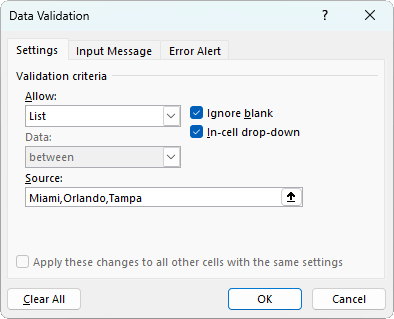
That works if you’re just getting started, but it quickly becomes a headache. Every time new values are added, you have to go back and edit the list manually.
The good news? Excel has multiple smarter ways to build drop-downs that update automatically, pull data from other sheets, and even change depending on your selection. In this guide, I’ll walk you through five powerful methods to take your Excel drop-downs to the next level.
Table of Contents
Watch the Video

Get the Excel Example File
Enter your email address below to download the free file.

1. Auto-Updating Drop-Downs with Tables
Instead of hard-coding values, put your list into a table. Tables in Excel are dynamic: they expand and contract as you add or remove data.
Steps:
1. Enter your list into a column.
2. Select it and go to Home > Format as Table.
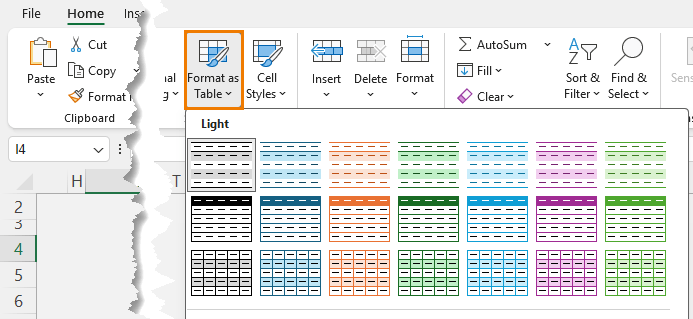
3. Create your drop-down list using Data > Data Validation > Allow: List.
4. In the Source box, select the table column instead of typing values.
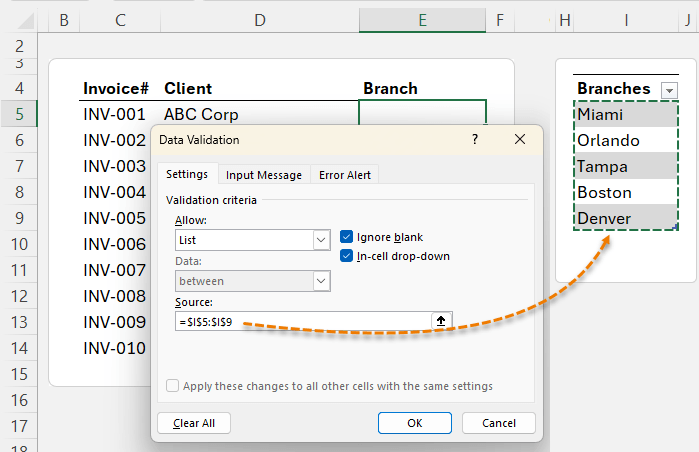
Now, whenever you add new items (e.g., Boston, Denver), your drop-down updates instantly.
⚠️ Note: This method only works if the list is on the same sheet. Let’s fix that next.
2. Lists on Other Sheets with Named Ranges
When your lists live on a separate worksheet (for tidiness), tables alone won’t auto-update. The solution is named ranges.
Steps:
1. Select your table column and go to Formulas > Define Name (e.g., DeptList).
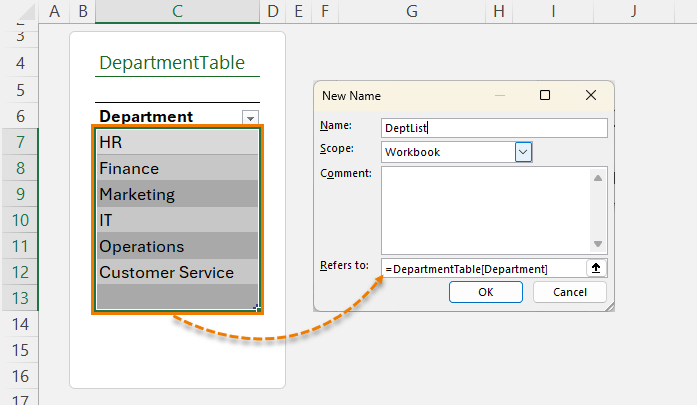
2. In your data validation, reference the name instead of the table column.
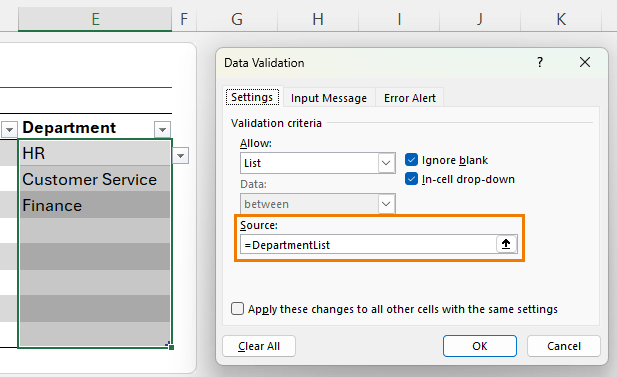
Now all drop-downs in the selected cells automatically include new entries.
💡 Bonus: Combine this with dynamic array formulas like SORT and UNIQUE to clean duplicates and blanks:
=SORT(UNIQUE(TOCOL(DepartmentTable[Department],1)))
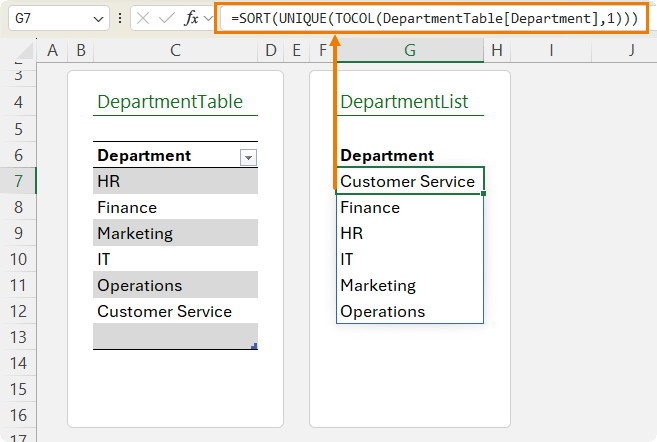
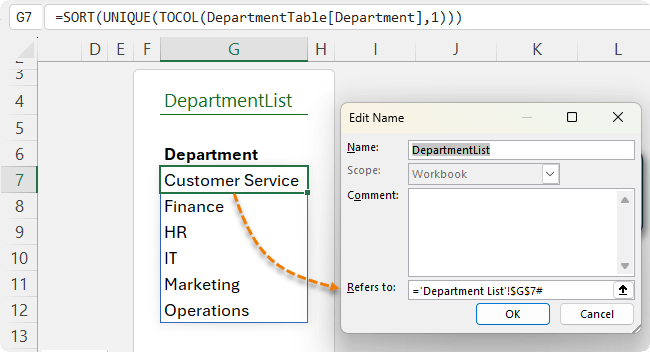
Define a name for this spilled list (e.g., DepartmentList) and reference it in your drop-down.
3. Dependent (Cascading) Drop-Downs
Want a list that changes depending on another selection? For example:
- In the Product Category column select Electronics → see only laptops, tablets, and monitors.
- Or select Furniture → see only desks, chairs, and cabinets.
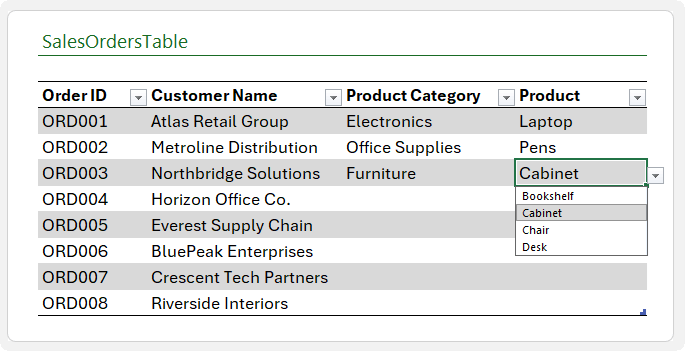
This is a dependent (or cascading) drop-down list.
How to set it up:
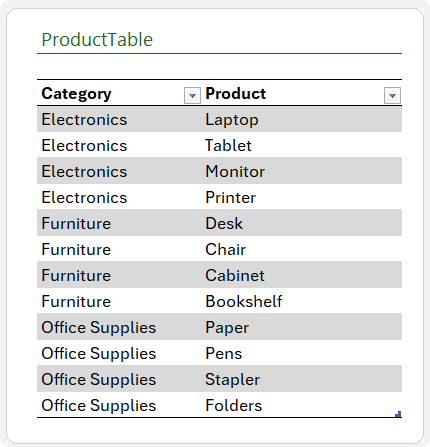
1. Build a lookup table of categories and products.
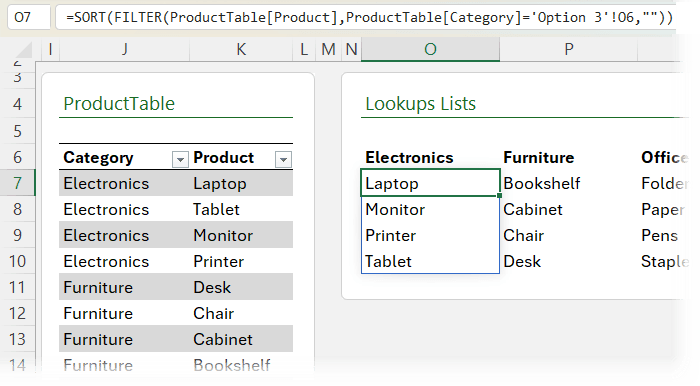
2. Use the SORT and FILTER functions to spill the product lists based on the category in row 6:
3. Use XLOOKUP to reference these spilled ranges in your data validation.
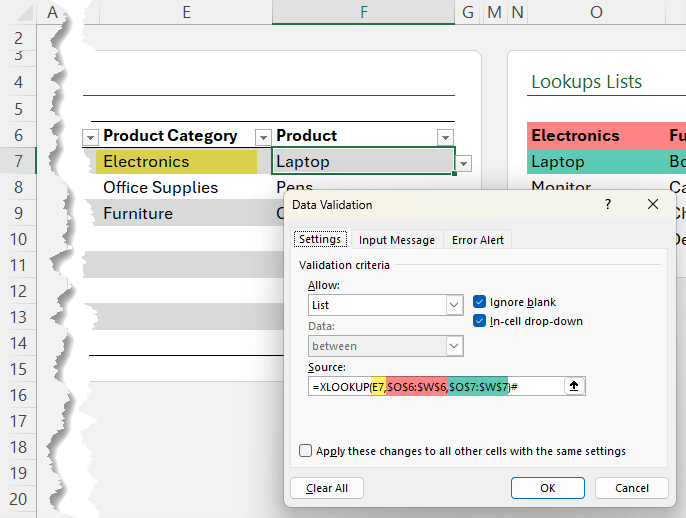
Result: error-proof data entry, faster selection, and a much cleaner experience.
Note: Check out the video above for step-by-step on setting up the lookup table so that it automatically updates as you add more product categories and products.
4. Drop-Downs That Fill in Related Data
Drop-downs can do more than limit choices, they can also auto-populate related information.
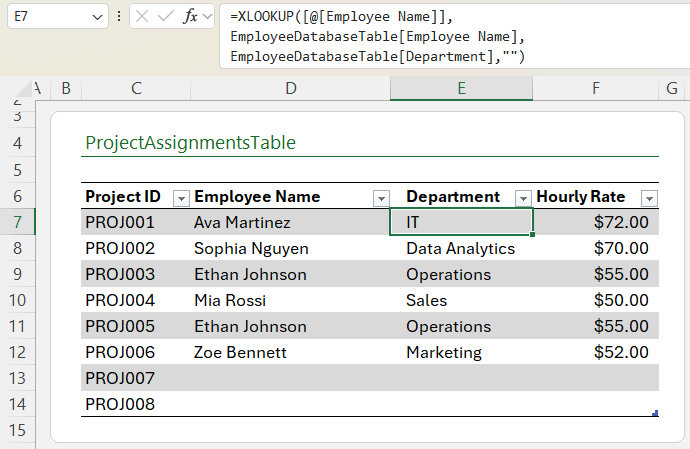
Example: Choose an employee in a drop-down, and Excel automatically fills in their Department and Hourly Rate.
Formula:
=XLOOKUP([@[Employee Name]],

EmployeeDatabaseTable[Employee Name],

EmployeeDatabaseTable[Department],"")
Copy across to retrieve multiple fields (e.g., Hourly Rate). This transforms your drop-downs into interactive forms that reduce manual entry and errors.
5. Excluding Items with FILTER
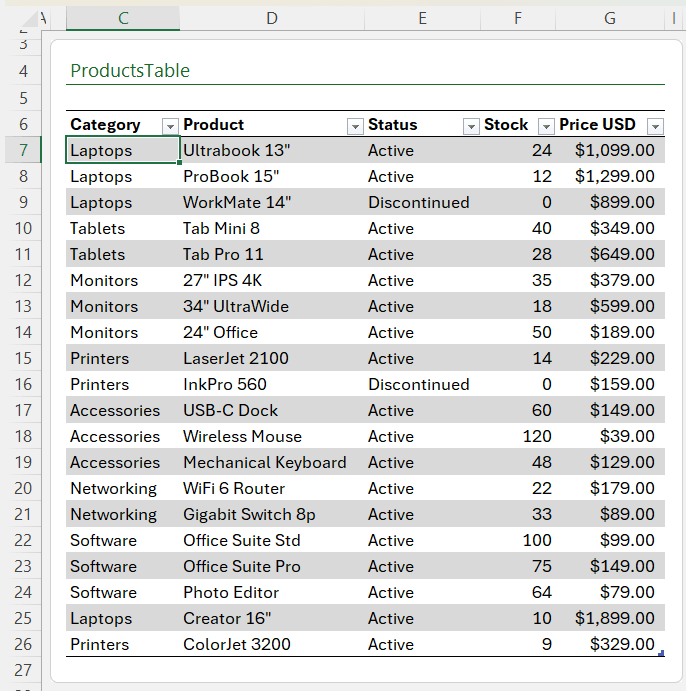
Here’s where modern Excel really shines. Suppose you have a product catalogue with “Active” and “Discontinued” statuses:
Instead of maintaining two lists, use the FILTER function.
Formula:
=SORT(UNIQUE(FILTER(ProductsTbl[Product],ProductsTbl[Status]="Active","")))
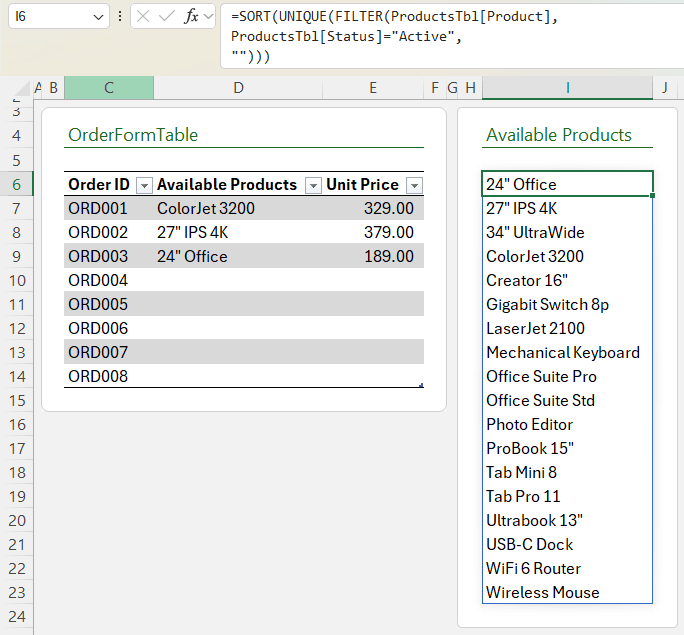
This ensures your drop-down always shows only active products, automatically sorted and de-duplicated:
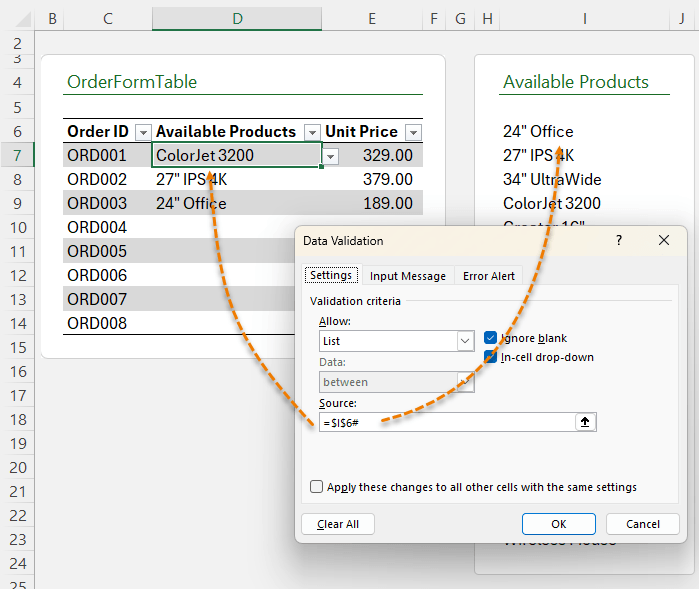
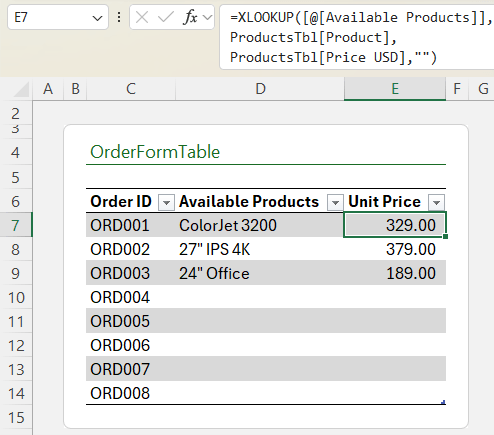
Pair it with XLOOKUP to return related details (like price).
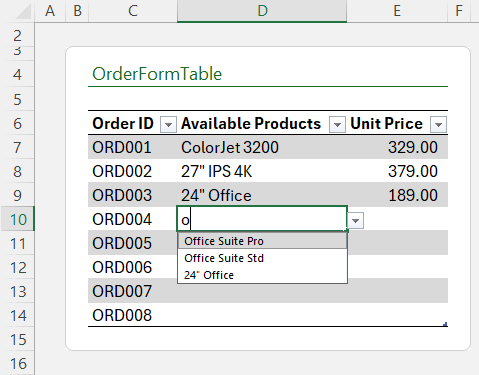
👉 In newer versions of Excel, drop-downs even let you search as you type, making selection even faster.
Why These Methods Matter
By combining Excel tools like Tables, Data Validation, Named Ranges, and Dynamic Array Functions, you can build drop-downs that:
- Save time by updating themselves.
- Prevent errors with dependent filtering.
- Provide instant lookup of related data.
- Scale to hundreds or thousands of options.
This is the difference between "just knowing Excel" and thinking like Excel.
Next Steps
If you want to go beyond drop-downs and master Excel at a professional level, check out my Excel Expert Course. It covers advanced formulas, dynamic arrays and more; complete with real-world projects and my personal mentoring.


Thank you kindly for the informative article.
Regarding the dependent/cascading drop-downs.
I currently use offset for these because i often have large sets of correlated values and building separate spill lists would not be practical because i would need hundreds and if a new value in a hierarchy appears i would need to create a new list for it.
Going with the example you have here in the article I would find the first row of the category, count the number of rows for that category and then use offset to provide the drop down options.
My question is if there is a more modern way of doing this because offset is a volatile function.
Thank you
Please post your question on our Excel forum where you can also upload a sample file and we can help you further.
A sixth option would be to use TRIMRANGE (and perhaps DROP). This could allow you to put the list on a separate sheet without necessarily having to turn it into a Table or create any Name references.
A formula like this can be used directly in the Source box for the Data Validation List:
=DROP(TRIMRANGE(‘Some Other Sheet’!A:A),1)
The TRIMRANGE allows the reference to remain dynamic and automatically pick up any new or removed values just like a Table, while DROP can discard any header value that would probably be in the top row.
This approach even has the added benefit of allowing multiple lists to be placed side by side (without skipping columns), which would have otherwise required them be part of the same Table, and which could then have caused a nuisance with blank cells when the lists had different numbers of values.
Nice, David. Thanks for sharing!